I’ve been working remote since ’06 – way before remote was cool – and I was in audio for 14 years before I started doing anything related to video. I still remember my first day working for an integrator back in ’00 and attending computer interface training from one of the ‘trons. I didn’t even know this ‘tron stuff existed before then. I say all that to say this: I’ve been around a while.
 As I mentioned, I’m remote and I’ve been on video calls using Skype, GoTo, Zoom, Teams and others for almost two decades. Granted, the audio I’ve heard from most one-on-one video calls has been almost acceptable with the other person’s laptop mic. Never great, but okay-ish. It’s the audio from the typical meeting room that has been the real problem. To describe it from the perspective of a far side participant, I will quote the late Scott Sharer, “It would have to suck to be better”.
“In the beginning”, meeting rooms used gooseneck mics, but the gooseneck farm was deemed ugly. So we moved to boundary and button mics, but they were subject to liquid spills, inadvertently covered up by folders or papers, or the laptop fan blew directly across the mic. Then we tried all sorts of ceiling mics from the big Plexiglas things to hanging shotgun and golf ball mics – all with varying levels of unsuccess. With each aesthetic “improvement” the mics kept getting further and further away from the participants – the audio source. If we kept moving displays further and further from the viewers like this, you would think we were nuts.
All too often, you’ll see a meeting room with a conference phone in the middle of a 20 ft. table. Or worse, they’re using a 360-degree ”bird” camera in the middle of that same table and they think they’ve achieved meeting equity. Or, the meeting room is an acoustic nightmare and the microphones are just too far away from the participants. While the people in the meeting room get a chance to converse, share ideas and come away with valuable information, the remote participants are left to fend for themselves as they haven’t been able to hear much of anything because of the poor and indistinguishable audio. If they can’t hear you, you can’t expect them to feel included and make meaningful contributions.
I also wonder how much poor audio may have affected career advancements for remotes when full participation with the larger group has been hindered in this way.
Admittedly, conferencing audio has improved over the years with the ceiling mic arrays and large wall mounted audio conferencing systems, but nothing replaces sticking a mic directly in front of someone’s face.
 In March of 2025, NPR ran a piece on All Things Considered about how people perceive you in relation to your audio and I think it’s worth quoting here:
“People who participate in online meetings using platforms like Zoom may want to pay closer attention to how their computer microphone alters the sound of their voice.
That’s because high-quality audio can make the speaker seem more attractive and convincing to others, according to results published in the Proceedings of the National Academy of Sciences.
Lower-quality audio, in contrast, can make people seem less appealing.”
Wow. No mention of video, lighting, framing or camera quality.
It’s all about the audio – whether it’s a one-on-one call or picking up a room full of people.
I consider audio to be the “blue-collar worker” of our AV world. Without audio, you’re not communicating. After all these years, I still believe that the audio is more difficult to get right than video because you while you can see light, you can’t see sound. Worse, most people seem to have the expectation that some new microphone located far from the participants or some new DSP can fix all things audio and acoustic. Yes, you can be heard but what about the quality and how you’re being perceived? Fast forward into the 23rd century and even Scotty couldn’t change the laws of physics.
Consider for a moment if the emphasis on meeting room design was flipped, and audio and acoustics became the primary considerations rather than the latest display technology or interior design fad.
Imagine better communication.
Imagine sounding more attractive and convincing to others.
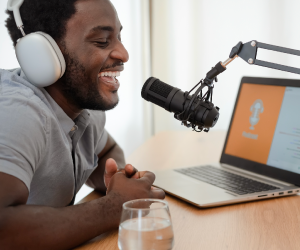 Being an “audio person”, I have always felt that my audio was important. I typically use a standard broadcast microphone model first introduced back in 1968. 1968. That’s not a misprint. That’s back when only 25% of households had a color television.
This mic is so good that it even has its own Wikipedia article. It uses a connector that’s been in use since at least 1955. The pinout for that connector was finally set by an AES standard a mere 33 years ago.
On the other end of the signal chain is the loudspeaker, typically a moving coil design patented back in 1925.
While the signal path in between the mic and loudspeaker could be analog or digital, the transducers on either end really haven’t changed that much.
You could argue that the quality of audio has certainly improved since 1925, especially on the loudspeaker side but the design of this broadcast standard microphone that I use almost every day is almost 60 years old and it’s still revered today.
Displays and cameras are great, but if you really want to improve your image, improve your audio.
NTSC, VGA, 4:3 have all come and gone. Basic audio is still just as essential as it has always been.
If you’re unsure of the best audio approach for your communication needs, let us know here at Almo ProAV. We have audio specialists ready to help.

Tom Kehr
CTS-D, CTS-I, Network+, LEED Green Associate, ISF-C, ATD Master Trainer
In-House System Designer and Trainer
Supported Applications: System Design