Why Corporate Meeting Spaces Are Moving to dvLED
In today’s corporate environment, the meeting room is where decisions get made, but for many organizations, it’s also where productivity is lost.
Employees now spend up to 11–17 hours per week in meetings, yet over 70% of meetings are considered unproductive. Add in poor visibility, inconsistent technology, and hybrid friction, and the cost becomes significant. U.S. businesses alone lose $37 billion annually to ineffective meetings.
The message is clear: better meeting experiences = measurable business impact.
That’s why organizations are rethinking the centerpiece of the room (the display) and turning to direct view LED (dvLED) solutions like the Panasonic TL‑137.
The Problem with Traditional Displays
Flat panels and projection systems introduce friction where it matters most:
- Limited screen size or scalability
- Reduced visibility in bright rooms
- Bezels breaking up critical content
- Inconsistent viewing across participants
In a world where meetings already consume up to 28% of the workweek, these inefficiencies compound quickly.
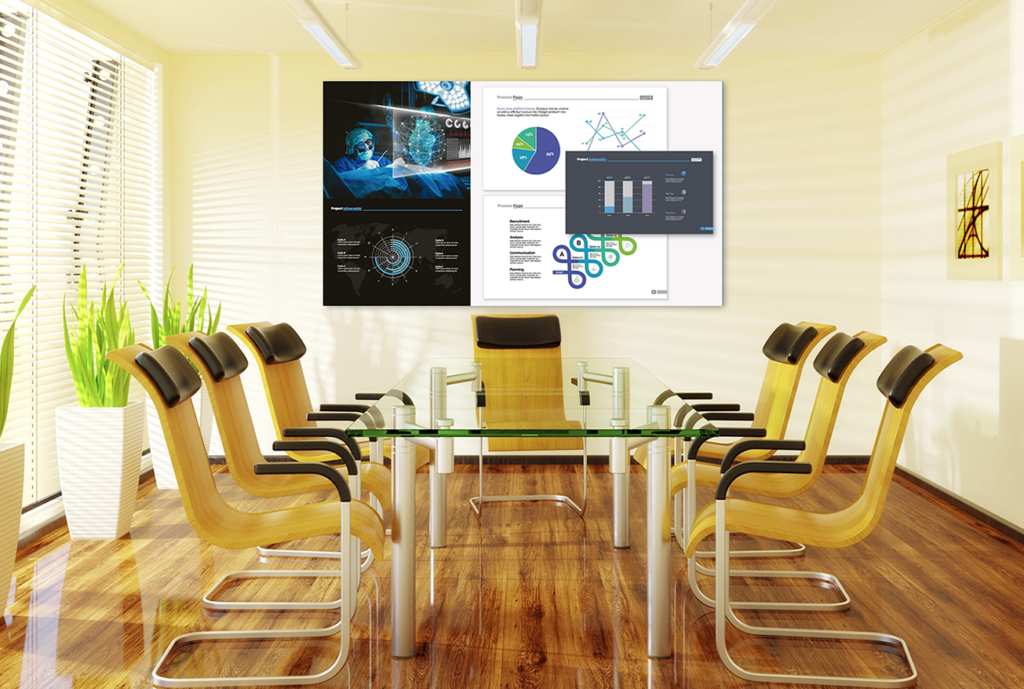
Why Direct View LED Drives Better Outcomes
dvLED isn’t just a visual upgrade…it’s a productivity tool.
Compared to traditional displays, dvLED delivers:
- Seamless, bezel-free canvases for uninterrupted content
- Higher brightness and contrast, even in daylight environments
- Wider viewing angles for consistent visibility across the room
- Scalability to match modern collaboration spaces
This directly supports more efficient meetings: clearer content reduces confusion, accelerates discussions, and enables faster decisions.
A Practical Path to dvLED: Panasonic TL‑137
Historically, dvLED came with complexity and cost barriers.
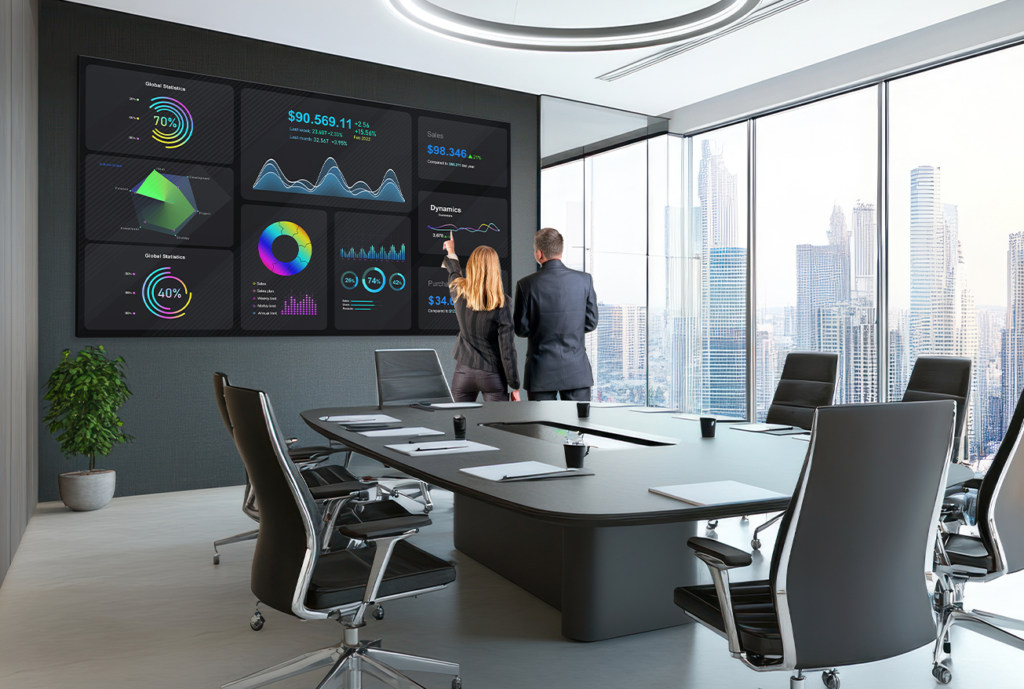
The Panasonic TL‑137 changes that with a 137” all-in-one dvLED display designed specifically for enterprise meeting spaces.
Key advantages:
- All-in-one design simplifies deployment and reduces install time
- Fine pixel pitch (~1.5mm) ensures crisp content – even up close
- High brightness (~700 nits) supports well-lit corporate spaces
- Front-serviceability minimizes downtime
→ Result: enterprise-grade performance without traditional LED complexity.
Built for ROI in the Modern Workplace
Today’s meeting spaces are IT-driven, and expected to deliver measurable returns.
Modern collaboration environments (like Teams Rooms) show:
- Up to 20% productivity improvement through better meeting experiences
- 75% reduction in travel costs through effective virtual collaboration
- 300%+ ROI with payback in 6 months for optimized meeting technology investments
When paired with high-performance displays like dvLED, these gains become even more impactful:
- Faster content comprehension
- Fewer meeting delays
- Reduced technical disruptions
→ Every improvement in clarity and usability translates into time, and cost, saved.
The Business Impact
Moving to dvLED delivers tangible value across the organization:
- Improved meeting efficiency in environments where time is already overallocated
- Higher engagement for both in-room and remote participants
- Lower total cost of ownership through long lifespan and reduced maintenance
- Future-ready infrastructure aligned with IT-managed AV environments
With employees wasting 31 hours per month in unproductive meetings, even small improvements in meeting effectiveness can drive significant ROI.
Final Thought
Corporate meeting rooms are no longer just functional…they’re strategic.
By combining high-performance collaboration platforms with next-gen display technology like the Panasonic TL‑137 dvLED, organizations can transform meetings from a productivity drain into a competitive advantage.
Because in today’s workplace, clearer communication doesn’t just look better…it performs better.
For questions about the new Panasonic TL-137 dvLED and other Panasonic solutions, please contact me or your Almo Pro AV Rep. Almo Pro AV has a full solution of Pro Audio and Video products and services available.

About the Author
Angie Greene | DSCE
Business Development Manager
Supported Manufacturers: Panasonic
 When it comes to
 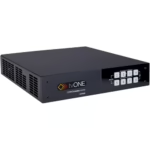 For more advanced installations,
 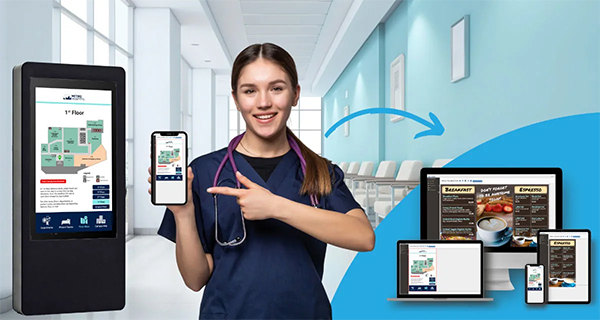 We’re seeing displays become intelligent communication hubs that support wayfinding, workplace collaboration, room scheduling, business dashboards, visitor engagement, emergency notifications, and interactive experiences. With cloud management, remote monitoring, automation, and AI continuing to evolve, digital signage is becoming a strategic business platform rather than just another AV system.


 We provide insight into:
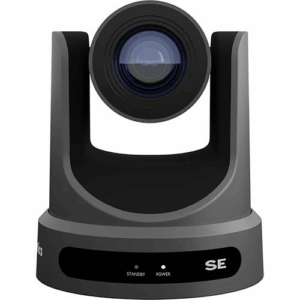 Stadiums in October aren’t just about football; they’re about atmosphere. Absen PL2.5 Pro, Samsung IAC, LG’s LAPA136-GF.AUSQ, Planar TVF, and MAXHUB LM138A07 LED walls make even the nosebleeds feel like front row. Epson EB-PU2220B projectors put replays on the big board brighter than the Florida sun. Christie Griffyn 4K32-RGB lights up end zones like Broadway, and Panasonic PT-MZ880 keeps multipurpose areas covered. Peerless-AV and Chief mounts hold it all steady, while Sennheiser EW-DX mics, JBL VTX arrays, and Crown I-Tech amps make every whistle and roar shake the concrete. And if you don’t have control? Forget it. AMX and Atlona keep the show running smooth so no one fumbles the AV on 4th down.

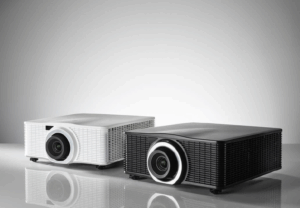 In Colombia, soccer stadiums are upgrading too. Imagine stepping into a venue with Absen LED walls lighting up the pitch, Barco G62 projectors handling pre-match visuals, and PTZOptics 30X-NDI cameras with Hive pushing live feeds straight to mobile apps and fan zones. Fans tune into ListenWiFi for play-by-play without missing a call, and the energy feels like Maracanã on a final. That’s the kind of AV that keeps fans in the moment instead of looking for the nearest exit.
 September is the last stretch of Q2 for us, and if I’ve learned anything in this industry, it’s that this month decides who walks into Q3 relaxed and who walks in scrambling. If you wait until November, you’ll be the one calling your customer to explain why their install is stuck on a boat. I have made those calls before and they are not fun.
 And I see it happening across the region right now. In Costa Rica, companies are already building hybrid rooms with
  Puerto Rico is another great example. A university there recently upgraded lecture halls with