AKG Wireless Microphones – An Overview

AKG Wireless Microphones

Selecting a wireless microphone system can be an intimidating experience. The amount of choices, configurations, and specifications available can be dizzying, even for those of us with experience in the industry.

Thankfully, AKG makes a wide range of high-quality wireless microphone systems to fit any application and budget, and once you know the major differences between them, you’ll be able to select the right product for your project in no time.

AKG wireless microphone systemWhat’s the Use (Case)?

Perhaps the most important consideration in selecting a wireless microphone system is where and how it will be used. Is it for a professional stage or broadcast environment where sound quality and reliability are paramount? Or is it for the lead singer for a local cover band where the highest quality for a limited budget is the key factor? Is it for a corporate or government environment where the signals may need to be encrypted to remain confidential? Identifying the needs of your end-user is the first step to determining which system is right for you.

Changing Channels

Another primary consideration is the number of simultaneous channels you will need at a particular location, as well as the amount of other wireless signals in the area. Professional touring environments may require as many as 40-50 open wireless channels (think stadiums, Broadway shows, large houses of worship), whereas a simple fitness studio may only require one or two. The ability to have a large number of simultaneous wireless channels running at the same time is a key differentiator in cost when it comes to wireless systems.

If you are installing the system in an area where there might be a considerable amount of wireless interference, such as a campus or dense urban environment, having a wide frequency range and the ability to easily identify clear frequency bands should be a prime consideration.

Digital vs. Analog

Newer digital wireless systems offer better audio quality and the ability to encrypt the signal for better security, but operate in the 2.4 GHz band, which is also where omnipresent WiFi and Bluetooth signals reside, so in dense commercial environments they may not be the best choice. Although analog RF-based systems operate on older technology, they are still the preferred choice for professional broadcast and live event systems.

So which AKG wireless system is right for you? Let’s take a look at their entire range and their pros and cons:

AKG WMS 40 MINI

AKG’s WMS 40 MINI series offers incredible value for the money. These are simple-to-operate, single-channel fixed-frequency systems which offer plug-and-play setup and a small form factor.

AKG PERCEPTION WIRELESS

The Perception Wireless series is an excellent choice for simple small-scale systems with a tight budget. It is an analog UHF-based system with basic frequency selection ability.

AKG WMS420

The most cost-effective professional system in the AKG range, the WMS420 offers a wide frequency selection band, detachable antennas to allow remote mounting, and rechargeable transmitters.

AKG WMS470

The WMS470 series is the best choice for a cost-efficient, high-performance, multi-channel system. Rechargeable batteries can be used and charged while remaining in the transmitter using the optional CU400 stand charger. The rear-mounted antennas can be detached for remote mounting.

AKG DMS100 & DMS300

The DMS100 and DMS300 systems are professional digital wireless systems from AKG, which offer pristine 24-bit/48 kHz audio and AES 256-bit encryption operating on the digital 2.4 GHz platform and are an excellent entry point to the world of digital wireless. The primary difference between the DMS100 and DMS300 is the simultaneous channel count – DMS100 allows up to (4), and the DMS300 allows up to (8).


AKG DMS800

The DMS800 is a reference professional-level digital wireless system designed for theaters, live productions, and tour sound applications. It offers the most accurate and reliable signal transmission in their digital line, and can be remotely monitored by Harman software.

AKG WMS4500

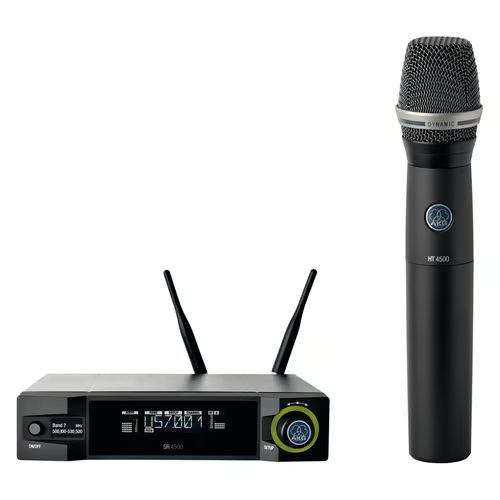
AKG’s flagship analog wireless system, the WMS4500, offers the highest channel quantity – up to (70) simultaneous channels, maximum reliability, and ultimate audio quality. Designed for touring sound, live performances, and broadcast applications, it is the system by which other AKG wireless systems are measured.

Conclusion

AKG offers a fit for every price point and project need. All of the above systems are available in a number of different configurations, with different transmitter options such as handheld, instrument, lavalier, and head-worn versions.

And don’t worry, if you still need assistance in selecting the appropriate AKG wireless system for your project, the Audio Team at Almo ProAV is here to help any time, at [email protected].

Audio enthusiast? Check out “Visiting the JBL Experience Center“.
John Rossman - headshot-frame

About the Author

John Rossman | CTS

BDM II – Technical Specialist

Supported Manufacturers: Harman ProfessionalAKG, AMX, BSS, Crown, DBX, JBL, Lexicon, Martin, & Soundcraft
Pro Audio Trends 2025: The Good, The Smart, and The Acoustically Ugly

As we continue to barrel through 2025 (how is it the middle of August already?!?), I wanted to take a second to look at some of the trends that are shaping pro audio in our current landscape. We are seeing a steady march of technological breakthroughs – particularly in the conferencing space – which make our lives as audio professionals easier and our solutions more effective. However, as they say – physics is physics – and the spaces in which we are having to implement these solutions are making our success harder and harder to come by.

Let’s take a look at the pro audio landscape in 2025 – the good and the not-so-good.

All 1s and 0s – Networked Audio

In my opinion, we can declare the networked audio wars over, and Dante has emerged the victor (for better or for worse). Although many networked audio protocols still exist and see limited, niche use (AVB, I’m looking in your direction…), Dante now sees the most widespread use and adoption across the pro audio industry. Dante has become so popular and inexpensive that we are now seeing it at almost every price point – from budget mixers to entry-level speakers, and even some in the consumer audio world.

Networked audio is such a revolution that it deserves its own blog post, but put simply, it maximizes installation convenience and flexibility by routing all audio channels through a digital, networked backbone of Cat cables and network switches. For example, an event that used to require 32 individual input cables run from the front to the back of the room can now be handled by one Cat6 cable.

Not only is networked audio convenient, but it is also incredibly flexible. Routing one input to multiple outputs can now be done with a few mouse clicks. Changes can be made on the fly without even having to touch a physical cable.

Will Dante be the ultimate networked audio solution into the future? Due to its channel count limitations, likely not. But for now, its ease of use, flexibility, widespread adoption, and low cost, Dante is the go-to solution for 2025 and at least the next few years.

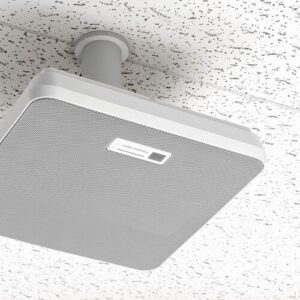
Audio-Technica beamforming ceiling micCeiling and Wall Microphone Arrays

We all work in the conferencing space extensively these days, and most of these spaces have the same needs: effective and professional-sounding audio which is as aesthetically unobtrusive as possible. Into this breech have stepped most of the major audio manufacturers – Shure, Yamaha, Sennheiser, Audio-Technica – with ceiling- or wall-mounted beamforming array microphones.

The amount of choices here is dizzying, but the technology in all of them is similar. They use sophisticated beamforming algorithms to isolate individual speakers, suppress background noise, and automatically adjust pickup patterns based on who is talking. Typically these are mounted on the ceiling, which eliminates the paper-shuffling noise of a table microphone, and the inconvenience and limited durability of gooseneck microphones.

Are beamforming microphones the correct solution for all conference rooms? Of course not. Most are limited to a maximum 25’x25’ coverage area, and audio at the edges of these coverage zones can sound thin. Locating microphones as close as possible to the speaker is always best practice, and some room configurations may not lend themselves to a ceiling mic array. Beamforming mics can also tend to be on the expensive side, so some situations may be better served by a more traditional solution.

The Challenge: Did Architects Forget About Sound?

modern conference roomFinally, for the trend that is assuredly NOT one that I hope sticks around, is the continued assault on acoustics that is modern conference room design. The aesthetics of modern conference room design seem to be engineered to be in direct opposition to what makes a room sound good.

Take a look at pretty much any conference room designed in the last 5-8 years: floor-to-ceiling glass walls and polished concrete floors that reflect every minute sound, exposed HVAC duct work that creates a continuous low-frequency rumble, open, cavernous ceiling spaces – it’s a miracle that we can hear anything intelligible in these spaces.

Although current mic and DSP technology can work miracles to overcome some of these challenges, the frustrating part of this is that with proper acoustic design choices, we wouldn’t need as many of these work-arounds. We are spending thousands of dollars on sophisticated signal processing to compensate for poor design choices.

These trends tend to come and go, so my fingers are firmly crossed that the open-ceiling, glass wall, concrete floor trends of this era go away – and quickly!

Wrapping Up

The professional audio industry has always been about solving problems and making communication clearer. We are seeing the promise of networked audio and advanced processing in action on a daily basis to make projects successful.

The future of pro audio is networked, intelligent, and unfortunately, still dealing with some questionable architectural choices.

If you need help finding the right technology for your next project, or have a difficult audio problem that needs solving, reach out to the audio team at Almo ProAV at [email protected]!

Audio enthusiast? Check out “Visiting the JBL Experience Center“.
John Rossman - headshot-frame

About the Author

John Rossman | CTS

BDM II – Technical Specialist

Supported Manufacturers: Harman ProfessionalAKG, AMX, BSS, Crown, DBX, JBL, Lexicon, Martin, & Soundcraft

Case Study: High School Stadium Audio Upgrade

One of the great parts about my job is that I get the chance to work on a wide range of exciting projects, each with their own unique challenges. The particulars of each project help keep me on my toes and ensure that we never apply a “one size fits all” approach. I wanted to share with you a recent high school stadium audio upgrade project that I worked on which is a great example of overcoming challenges – and bringing in external resources to help bring things home.

A customer came to us with an opportunity to upgrade a high school football stadium’s sound system, which was working but in need of a refresh. The existing sound system consisted of a series of Community outdoor loudspeakers mounted above the home side press box:

stadium press box

Although these speakers were functional, attendees were complaining that announcements and music could not be heard over the crowd noise, particularly at larger events with a full capacity crowd, and particularly on the visitors’ stands, which are over 400’ away on the other side of the stadium.

stadium aerial view

My first thought was to add speakers to the light poles on the visitors’ side to improve coverage and intelligibility. However, according to the customer, the school was unwilling to add trenching to the other side for this project, and there were no known pathways connecting the two sides.

With this disappointing piece of news in hand, I knew I needed a second opinion, so I decided to reach out to one of the most capable and helpful people in the industry – Harman’s Dave Tewksbury. Dave is an amazing and knowledgeable resource on all things JBL and BSS, and I knew he could help to find a creative solution.

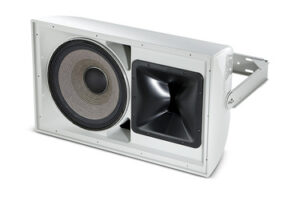
AW566 loud speakersAfter explaining the limitations of the project, Dave surprised me when he stated that JBL’s AW series of speakers (the AW566 in particular) have the ability to project over that distance when paired with the proper amount of amplification.
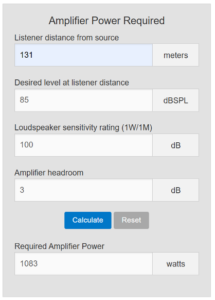
But what is the proper amount of amplification? In order to determine that, we need to have a target sound pressure level at a given distance. Although ideally we would want something above 90 dB SPL to truly overcome all crowd noise, the amount of amplification required to hit that from 430’ away would be both impractical and would overload the speaker.

Together we settled on a target of 85 dB SPL, which according to both Crown’s amplifier power calculator and JBL engineers, would require approximately 1083 watts of power for the AW566:

amplifier requirementsFinally, something we could work with! We settled on the Crown DCi 2×1250 to power (2) JBL AW566 loudspeakers mounted above the press box to provide sound to the visitors’ side. The home side situation was much easier to solve for – it simply required selecting speakers with the appropriate coverage patterns. Those turned out to be (3) JBL AWC82 speakers, powered by a Crown DCi 4×600. We also recommended relocating the home side speakers so that they would no longer be in the acoustic shadow of the press box roof, as the previous Community speakers were.
Through all of this legwork we were able to provide the customer with a reasonably-priced solution to drastically improve the acoustics and intelligibility of their sound system. We were able to navigate challenges which prevented implementing the “ideal” solution, and were able to provide them with an easy-to-implement significant upgrade to their current system.

My thanks as always to the invaluable Dave Tewksbury, as well as all of the great folks at Harman, for their continued support, knowledge, and help!

If you are interested in more information on amplifier power and speaker ratings, Crown has an excellent guide on their website, and if you need help with a complex or challenging audio project, simply send an email to [email protected] and our team of experts will be there to help!

Check out John’s other recent blog: “Digital Signal Processors – a Beginner’s Guide“.
John Rossman - headshot-frame

About the Author

John Rossman | CTS

BDM II – Technical Specialist

Supported Manufacturers: Harman ProfessionalAKG, AMX, BSS, Crown, DBX, JBL, Lexicon, Martin, & Soundcraft

Digital Signal Processors – a Beginner’s Guide

I was recently asked to advise on a project where the customer was installing new AV equipment in a public meeting space. The audio system was to include ceiling array microphones, gooseneck podium microphones, as well as a number of wireless lavalier and handheld microphones. The question I was being asked was “can you recommend an appropriate mixer for this application?”.

At first glance, an audio mixer seems to be the appropriate tool for the job – after all, a mixer takes a number of audio input sources, allows you to control the volume and equalization of each source, and mixes them into a combined output signal to be sent to an amplifier and eventually loudspeakers.

But what if you need to send multiple output signals to multiple destinations? What if some signals need to be sent to some outputs but not others? What if you need to instantly change the signal routing based on the room configuration? What if you need to apply auto echo cancellation (AEC) to any of the signals to prevent echo and feedback? And most importantly – what if you do not have a dedicated technician willing and able to sit behind the mixer to configure it and make adjustments?

For all of these reasons (and plenty more), the appropriate tool for this application is a digital signal processor (DSP), not a mixer. So, let us take a look at DSPs, their features and benefits, and where they are appropriate (and not) to use!

Anatomy of a DSP

One way of looking at a DSP is as a “mixer in a box” which can be remotely controlled. Similar to a mixer, a DSP will have a number of input channels and output channels – typically 12 (in) x 8 (out) – but many other configurations exist. Unlike a mixer, which is made to lay on a table or desk and features lots of volume sliders and knobs, a DSP is a small box which is made to be installed in an equipment rack and typically features no knobs or obvious controls.

blu101Below is the front and rear of a BSS BLU-101, one of the most popular and powerful DSPs that we sell:

As you can see, it does not look much like a mixer at all, but the functionality is similar. It has twelve inputs (the green ports on the right side), eight outputs (the orange ports in the middle), an ethernet port for connecting it to a network, an RS232 port for allowing the unit to be controlled remotely, BluLink for connecting to other Harman devices, and a set of GPIO control ports which can be used for monitoring other devices or accepting signals from external devices.

ac5swhtusAs mentioned above, there are not any controls or buttons on the front panel. Instead, DSPs are generally controlled by external control systems, such as AMX, Kramer, or Atlona. Users interact with a custom touch panel to send control signals such as channel mute, volume control, input/output routing and mixing, gating, and more! In simpler systems, BSS DSPs can also be controlled by a simple button/volume knob control panel, such as the BSS Contrio series.
Due to the versatility and abilities of DSPs, they do require configuration and setup before being deployed. When selling a DSP, always check to make sure that your customer has someone on their team who is familiar with configuring and setting up DSPs. In most cases, the manufacturer will have online training programs which can help them get up to speed. For example, Harman’s Professional Training Portal offers full courses on BSS programming for free! If the customer needs additional help or is simply pressed for time, Almo’s own LinkLab Professional Services team has certified DSP programmers ready to help!

When to Recommend a DSP

Now that you know a bit about what makes a DSP tick, when should you be recommending a DSP solution over a regular mixer?

  • Medium to Large Conference Rooms: any time a customer mentions conferencing, particularly for larger rooms with multiple microphones, a DSP should be recommended. DSPs have the flexibility and power to manage the complex routing needed to interface with conferencing devices. Make sure that your DSP has a USB port for conferencing, as well as auto echo cancellation (AEC)!
  • Training Rooms/Lecture Halls: for applications where there will not be a dedicated AV Tech available to manage the system, a DSP with preset scene recall and automatic level control is essential.
  • Building-wide Systems: any complex system where multiple rooms are being controlled from a central head-end system requires a DSP (and usually a large one) to manage the routing of audio from room to room.

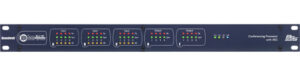
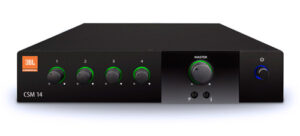
cms14Of course, a DSP is not a fit for every situation. For example, most live performances (musical or otherwise) are better suited to being controlled by a real live person in front of a mixer who can respond in real time to the action on stage. Additionally, smaller, less complex systems (such as in a bar, restaurant, or retail store) which do not require advanced routing or signal control might be better suited to use a rack-mounted mixer (such as the JBL CSM series) or a zone controller (such as the dbx ZonePro).

Conclusion

Hopefully, this serves as a good introduction into the capabilities and use cases for audio digital signal processors. Do not be intimidated by the complexities of DSPs – at their heart they are simply tools for making audio sound great and getting it where it needs to go.

The good news is that you do not have to be an expert to sell DSPs. The audio team at Almo is here to help you navigate the details. Simply be on the lookout for the opportunity, ask some questions, and email [email protected] to help figure out the details. We are here to help!

Audio enthusiast? Check out “Visiting the JBL Experience Center“.
John Rossman - headshot-frame

About the Author

John Rossman | CTS

BDM II – Technical Specialist

Supported Manufacturers: Harman ProfessionalAKG, AMX, BSS, Crown, DBX, JBL, Lexicon, Martin, & Soundcraft

Visiting the JBL Experience Center

During the last week of January 2025, I had the amazing opportunity to visit the JBL Experience Center in Los Angeles, California. Our fantastic NBT team was invited to host their Lead Summit there and I was lucky enough to get to tag along!

The Experience Center is located in a lovely area of LA – Northridge, CA – and was lucky enough to have escaped the recent wildfire incidents. A sprawling complex, the building is home to both the Experience Center and offices for JBL and Harman engineers, sales and marketing teams, and executives.

We arrived early in the morning and were greeted by JBL wizard David “Tewks” Tewksbury, who served as our tour guide and host for the day. After dropping our bags off in the conference room, we were escorted to the entryway of the Experience Center, which was a feast for the eyes and ears. JBL’s three Grammy awards were showcased in a long hallway which featured JBL Control 126 in-wall speakers playing some light background music. Martin LED lighting strips were programmed to dance to the music, and an AMX Varia touch panel allowed quick control of a number of preset scenes to set the mood.

welcome Exertis Almo From there we were greeted with a personalized surprise – the huge Samsung video wall in the lobby had been customized to welcome the Exertis Almo team to the Experience Center!

One of the best parts of the Experience Center…experience…is that nearly all of the Harman products on display are powered on and ready to be demonstrated. Getting the chance to play with touch panels, hear headphones, test microphones, and hear loudspeakers is not only a fantastic learning experience, but a lot of fun as well!

For example, AKG had two fantastic setups in the main lobby which were a hit with our group – a headphone demo wall and a vocal isolation booth for testing AKG microphones! The headphone demo wall had all of AKG’s studio headphones ready to demo – after donning the headphones of your choice you could select from any of eight music tracks and control volume directly from an AMX touch panel. The vocal demo booth featured AKG’s famous studio microphones – the C214, C314, and the venerable C414 XLii, and a small JBL audio on displaySoundcraft mixer so that you could easily switch between the different models – a very enlightening experience for a mic nerd like myself!

Near the mic and headphone demo areas were rooms highlighting JBL’s consumer and pro-sumer home, Bluetooth, and studio products. JBL’s attractive home audio products like bookshelf speakers, turntables, headphones, PartyBoxes, and other Bluetooth speakers were set up to demo and interact with. Getting to hear the JBL 104-BT desktop monitor speakers in person was the nudge I needed to finally get a set for my work desk at home.

jbl loudspeakers trainingBut all of this was just an introduction to the main hall, where JBL loudspeakers, Crown amplifiers, BSS and dbx signal processors, AMX control and video products, and Martin lighting were on full display. Harman has put a lot of effort into this room, and they make it easy to demo, see, and A/B their installed product lineups. Tewks led us though the experience, explaining the differences between the various Crown amplifier series, discussing and demoing the multitude of JBL ceiling and wall-mounted loudspeakers and explaining fun stuff like speaker waveguides.

All of this was powered by one of the prettiest AV equipment rack lineups I’ve ever seen, behind glass and beautifully lit by adjustable RGB lighting. I’ve never considered aesthetically lighting an equipment rack before, but my mind has been changed!jbl equipment racks

If all of this wasn’t enough, the highlight – by far – of our tour was getting to see and hear the brand-new audio demo room. The demo room was recently renovated and professionally acoustically treated, which was amazing to see and hear in person. The large room featured most of JBL’s compact line arrays (such as the CBT 70J-1 and CBT 1000) and outdoor all-weather speakers on one wall. We were able to hear all of these in-situ and compare their advantages and strengths. The outstanding even horizontal coverage and throw distance of these speakers has to be heard to be believed.

jbl line array speakersOn the other wall, at a relatively safe distance, were JBL’s line array speakers flown from the ceiling. The SRX, VRX, and VTX-series line array speakers are JBL’s flagship offerings for large venues, and its not everyday you get to hear this level of performance in a private setting. The folks at Harman very cleverly configured the line array demo to start at the push of a big red button – our own Brent Dowler got to do the honors. After the button was pushed, the lights went down and the show started.

Massive walls of sound – loud, but accurate, crisp, and clear – roared through the room, accompanied by a concert-level Martin lighting show, choreographed to match the music. Everything from hard rock to EDM sounded incredible. The performance literally made the hair stand up on the back of my neck!

After that experience we needed to wind down a little, so we got a chance to relax in JBL’s new Cinema Experience Room, where we got to hear JBL’s excellent range of cinema speakers in a theater-like setting. This room also housed a demo of JBL’s new Control 400 series ceiling speakers, where they could be compared to competitors’ ceiling speaker offerings.

This write-up only scratches the surface of what we got to see and hear at the JBL Experience Center; I’m running out of room and I didn’t even mention the classic JBL speaker displays, the speaker torture test rooms, and the fantastic AMX and Samsung video wall displays. My thanks to our NBT team for inviting me and to Tewks and the rest of the Harman staff for welcoming us!

If you are interested in experiencing the JBL Experience Center for yourself, reach out to me! I’d love an excuse to go back myself.

Want more audio tips? Check out “JBL Ceiling Speakers Demystified“.
John Rossman - headshot-frame

About the Author

John Rossman | CTS

BDM II – Technical Specialist

Supported Manufacturers: Harman ProfessionalAKG, AMX, BSS, Crown, DBX, JBL, Lexicon, Martin, & Soundcraft

Pin It on Pinterest