Is TAA-Compliance Required for Audio?
Let’s explore the details and nuances of TAA compliance in the context of audio equipment.
 First, what is TAA compliance?
As defined by the Government Services Administration, Trade Agreement Act (TAA) Compliance refers to certain requirements and guidelines that products must meet when operating within United States government applications. The GSA notes that products may fit into two categories to be considered TAA Compliant:
- Articles that are wholly the growth, product, or manufacturer of the U.S. or a designated country.
- Articles that are “substantially transformed” in the U.S. or a designated country into a new and different article of commerce with a name, character, or use distinct from that of the article or articles from which it was transformed.
 If you are looking to learn more, you can find the full details here.
In a conversation with Tom Kehr, Exertis Almo Systems Designer and Trainer, he provides insight into the uses, trends, and requirements of TAA-compliance audio products.
He explains that TAA-compliance is normally for government uses, applying to government agencies and government contractors. In fact, Tom notes that TAA-compliance is not only becoming more of a requirement in audio products, but also with the components.
“The thought process behind TAA-compliance is to mitigate issues getting products,” he said. “If current trade practices are disrupted in a certain area, it depends on whether or not they can continue their business.”
Josh Taylor, Exertis Almo Director of Pro AV Sales, and Trae Fackler, Exertis Almo Senior Account Manager, detail the popularity of TAA-compliant solutions, stating that between the end of fall and the beginning of summer, about half of the quotes are going to revolve around TAA-compliance. Additionally, they explain that TAA-compliance is typically the focus for government applications, above price and availability.
“It all depends on the end user and the end location,” Trae explained. “The dealer usually informs up upfront and states that TAA-compliance is a requirement.”
 Moreover, a key component of TAA-compliance is the idea of substantial transformation, and navigating TAA-compliance comes with challenges. Manufacturers ensure compliance through third-party validation of their products, but complexities arise due to the varying interpretations of “substantial transformation” and the origin of components. This process depends on the product and tends to be quite subjective, as independent companies can validate whether there is enough of a difference between an incoming part and a final product.
While the above definitions explain that TAA-compliant products must be manufactured or substantially transformed in the U.S. or a designated country, it’s also important to understand the distinction between TAA-compliant products and TAA-certified products.
When speaking with Petro Shimonishi, Director of Product Management at Panasonic Connect North America, she provided insight into the confusion and complications that arise with TAA-compliance, explaining that the higher level of security, the more detailed the requirements. In fact, Petro explained the difference between government agencies in relation to TAA-compliant products.
“State and local governments are not required to have TAA-compliance, unless they’re funded by federal grants or funding,” she explained. “Since the terms of the funding might need to comply with federal procurement, resellers should consider state and local government applications for this reason.”
 She also notes that there is a great deal of business in education applications, as most of their contracts are funded by the federal government, and there are often changes in the about of funding received. It is advisable to provide products that meet federal acquisition regulations (FAR), ensuring adherence to security, labor, and environmental standards.
For those aiming to expand into government contracts, familiarity with TAA compliance is essential. And as the landscape continues to evolve, staying updated and proactive in TAA compliance will be pivotal for success in the government sector.
As far as TAA compliance for Audio products, I think it’s still something that’s evolving with time. There are only a few manufactures that offer TAA compliance for Audio products today. However, it’s most important to make sure you are sourcing your products from reputable legitimate and reputable organizations such as us, Exertis Almo. Especially to minimize any legal risk from the government from fraudulent product origination. The second key takeaway is to educate yourself and review all terms and conditions when working with state and local governments on their bid requirements. If they are utilizing federal grant monies, you could be tied to supply TAA compliance products.
If you aren’t sure about any products, please ask for the country of origin to be supplied to you.
I hope you’ve walked away with just a little bit more knowledge about TAA-compliance.
Bottom line, please reach out to your Exertis Almo Rep or myself for assistance with any of our solutions! We are here to provide you will full solutions to meet all your needs inclusive of TAA-compliance products.

Angie Greene | DSCE
Business Development Manager
Supported Manufacturers: ScreenBeam and Panasonic
 Let’s explore the differences between distributor and manufacturer services and how they can complement each other to unlock value.
 Like distributor services, manufacturer services focus on creating a long-lasting relationship with customers by delivering support for all products within their brand. In my conversation with
  Of course, they have to keep up with product changes and technological advancements to offer good recommendations to you or me. Yes, they can research the details, although your best sales professionals are ahead of the curve. They want to be the ones to introduce the technology to you to be a true consultant in offering you the solutions. That’s their value, and they know it!
 As the liaison between a device and a display, Miracast utilizes wireless technology to detect, connect, and mirror the screen of one device on the other. The up-and-coming technology serves as a peer-to-peer network to wirelessly transmit screencasts comprised of WiFi Direct connections, comparable to Bluetooth’s function. In fact, Miracast allows content reproduction from TVs, smartphones, and more – all onto users’ PC screens.
 Along with the real-time content transmission, Miracast provides content protection through its support of High-Bandwidth Digital Content Protection – or HDCP. The mechanism oversees the transfer of content between the device that originates the content (the source) and the display device, providing an added layer of security to a user’s digital rights.
 In fact, Miracast technology is available on a variety of wireless devices from
  When designing or renovating a classroom, there are several key factors that affect an integrator’s decision in choosing to install a display or a projector. Generally speaking, the decision is based on the room size, seating layout, and light levels of the overall environment – both natural and overhead lighting included.
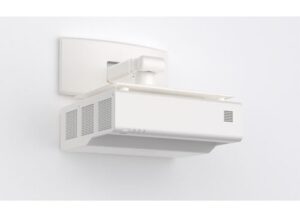 including a 21:9 aspect ratio for hybrid learning and remote collaboration. Perfect for the education space, the projector features a compact design and long-lasting power. Plus, the simple set-up and wall-mounted installation provides crystal-clear images up to 120” with little to no chances of projector shadows from the presenter.
 Additionally, we’ve seen an increased demand for both displays and projectors in hy-flex classrooms, which follow a small group-based layout. These learning spaces feature a main projector, or several, at the front of the classroom, but separate students into small groups, each with their own individual display at their meeting table. The professor can walk around the room and supervise the individual groups, with the capability to transmit a video feed from the small group displays to the main projector to share content with the whole class.