Digital Signal Processors – a Beginner’s Guide
At first glance, an audio mixer seems to be the appropriate tool for the job – after all, a mixer takes a number of audio input sources, allows you to control the volume and equalization of each source, and mixes them into a combined output signal to be sent to an amplifier and eventually loudspeakers.
But what if you need to send multiple output signals to multiple destinations? What if some signals need to be sent to some outputs but not others? What if you need to instantly change the signal routing based on the room configuration? What if you need to apply auto echo cancellation (AEC) to any of the signals to prevent echo and feedback? And most importantly – what if you do not have a dedicated technician willing and able to sit behind the mixer to configure it and make adjustments?
For all of these reasons (and plenty more), the appropriate tool for this application is a digital signal processor (DSP), not a mixer. So, let us take a look at DSPs, their features and benefits, and where they are appropriate (and not) to use!
Anatomy of a DSP
One way of looking at a DSP is as a “mixer in a box” which can be remotely controlled. Similar to a mixer, a DSP will have a number of input channels and output channels – typically 12 (in) x 8 (out) – but many other configurations exist. Unlike a mixer, which is made to lay on a table or desk and features lots of volume sliders and knobs, a DSP is a small box which is made to be installed in an equipment rack and typically features no knobs or obvious controls.
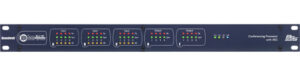 Below is the front and rear of a BSS BLU-101, one of the most popular and powerful DSPs that we sell:
As you can see, it does not look much like a mixer at all, but the functionality is similar. It has twelve inputs (the green ports on the right side), eight outputs (the orange ports in the middle), an ethernet port for connecting it to a network, an RS232 port for allowing the unit to be controlled remotely, BluLink for connecting to other Harman devices, and a set of GPIO control ports which can be used for monitoring other devices or accepting signals from external devices.
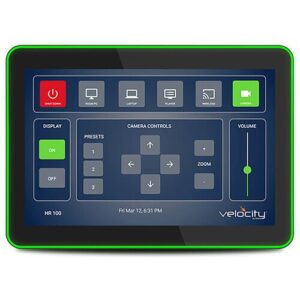
 As mentioned above, there are not any controls or buttons on the front panel. Instead, DSPs are generally controlled by external control systems, such as AMX, Kramer, or Atlona. Users interact with a custom touch panel to send control signals such as channel mute, volume control, input/output routing and mixing, gating, and more! In simpler systems, BSS DSPs can also be controlled by a simple button/volume knob control panel, such as the BSS Contrio series.
Due to the versatility and abilities of DSPs, they do require configuration and setup before being deployed. When selling a DSP, always check to make sure that your customer has someone on their team who is familiar with configuring and setting up DSPs. In most cases, the manufacturer will have online training programs which can help them get up to speed. For example, Harman’s Professional Training Portal offers full courses on BSS programming for free! If the customer needs additional help or is simply pressed for time, Almo’s own LinkLab Professional Services team has certified DSP programmers ready to help!
When to Recommend a DSP
Now that you know a bit about what makes a DSP tick, when should you be recommending a DSP solution over a regular mixer?
- Medium to Large Conference Rooms: any time a customer mentions conferencing, particularly for larger rooms with multiple microphones, a DSP should be recommended. DSPs have the flexibility and power to manage the complex routing needed to interface with conferencing devices. Make sure that your DSP has a USB port for conferencing, as well as auto echo cancellation (AEC)!
- Training Rooms/Lecture Halls: for applications where there will not be a dedicated AV Tech available to manage the system, a DSP with preset scene recall and automatic level control is essential.
- Building-wide Systems: any complex system where multiple rooms are being controlled from a central head-end system requires a DSP (and usually a large one) to manage the routing of audio from room to room.
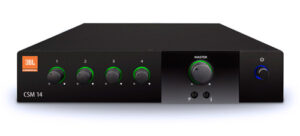 Of course, a DSP is not a fit for every situation. For example, most live performances (musical or otherwise) are better suited to being controlled by a real live person in front of a mixer who can respond in real time to the action on stage. Additionally, smaller, less complex systems (such as in a bar, restaurant, or retail store) which do not require advanced routing or signal control might be better suited to use a rack-mounted mixer (such as the JBL CSM series) or a zone controller (such as the dbx ZonePro).
Conclusion
Hopefully, this serves as a good introduction into the capabilities and use cases for audio digital signal processors. Do not be intimidated by the complexities of DSPs – at their heart they are simply tools for making audio sound great and getting it where it needs to go.
The good news is that you do not have to be an expert to sell DSPs. The audio team at Almo is here to help you navigate the details. Simply be on the lookout for the opportunity, ask some questions, and email [email protected] to help figure out the details. We are here to help!

About the Author
John Rossman | CTS
BDM II – Technical Specialist
Supported Manufacturers: Harman Professional – AKG, AMX, BSS, Crown, DBX, JBL, Lexicon, Martin, & Soundcraft
 From there we were greeted with a personalized surprise – the huge Samsung video wall in the lobby had been customized to welcome the Exertis Almo team to the Experience Center!
 Soundcraft mixer so that you could easily switch between the different models – a very enlightening experience for a mic nerd like myself!
 But all of this was just an introduction to the main hall, where JBL loudspeakers, Crown amplifiers, BSS and dbx signal processors, AMX control and video products, and Martin lighting were on full display. Harman has put a lot of effort into this room, and they make it easy to demo, see, and A/B their installed product lineups. Tewks led us though the experience, explaining the differences between the various Crown amplifier series, discussing and demoing the multitude of JBL ceiling and wall-mounted loudspeakers and explaining fun stuff like speaker waveguides.
 On the other wall, at a relatively safe distance, were JBL’s line array speakers flown from the ceiling. The SRX, VRX, and VTX-series line array speakers are JBL’s flagship offerings for large venues, and its not everyday you get to hear this level of performance in a private setting. The folks at Harman very cleverly configured the line array demo to start at the push of a big red button – our own Brent Dowler got to do the honors. After the button was pushed, the lights went down and the show started.
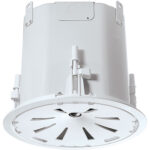 Here we have the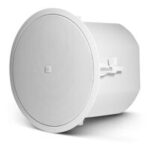
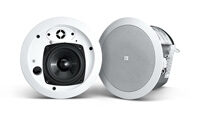
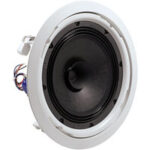 Similarly, for a paging application where aesthetics are a consideration, the
 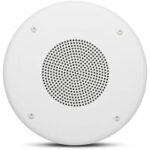 Please note that despite the overlap between JBL models between various series, you should not assume that there is always an “apples-to-apples” comparison. For example, some series will have necessary accessories or features included like back cans or tile bridges, while others may not. Always research to make sure you are making the right choice, and contact us if you have questions!
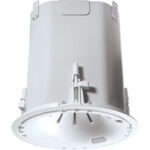 Does your project have any special circumstances where a typical ceiling speaker won’t work? Don’t worry – JBL has you covered!
 Have a ceiling with limited above-ceiling clearance? Try the
 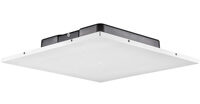 Looking for a low-profile speaker which is easy to install and fits seamlessly into a standard drop-tile ceiling? Try the
  Before installing audio equipment, it’s important to evaluate the space itself, as there are many factors that affect audio quality. It’s essential to consider the acoustics of an environment, as a particular space might require a few changes to adjust the echo and create a more comfortable listening experience once the audio equipment is installed.
 See the products in action.